
✅Medically reviewed
Osteoarthritis is the disease that most often starts with knee pain, especially after 50. However, knee pain without injury can also signal rheumatoid arthritis, gout, pseudogout, psoriatic arthritis, lupus, Lyme disease or a joint infection. In children, it may point to Osgood-Schlatter disease, a hip problem or, rarely, bone cancer. Above all, a hot, swollen knee with fever is an emergency.
Knee Pain With No Injury: Why It Matters
Your knee starts aching. Perhaps it came on slowly, or perhaps it woke you last night. You have not fallen or twisted it, yet the pain keeps coming back.
In fact, knee pain with no obvious injury is one of the most common reasons people see a doctor. It matters because a hidden disease often shows itself in the knee first, sometimes months before any other symptom.
In this guide, you will find 14 conditions that can begin with knee pain. For each one, we explain how it feels, which test usually confirms it, and when you need help urgently.
Why the Knee Often Warns You First
First, the knee carries your body weight through thousands of steps a day. In addition, it relies on cartilage, ligaments, tendons, fluid-filled sacs (bursae) and a soft inner lining called the synovium to work together.
That lining matters more than most people realise. In many types of arthritis, inflammation of the synovium (synovitis) actually drives the swelling, stiffness and pain. As a result, two people with similar X-rays can feel very different levels of pain.
Watch: Mr Abbas explains where knee pain really comes from in this short video: Where Does Knee Pain Really Come From? (YouTube)
14 Diseases That Can Start With Knee Pain
Below, we start with the most common causes and finish with the rare but serious ones.
1. Osteoarthritis
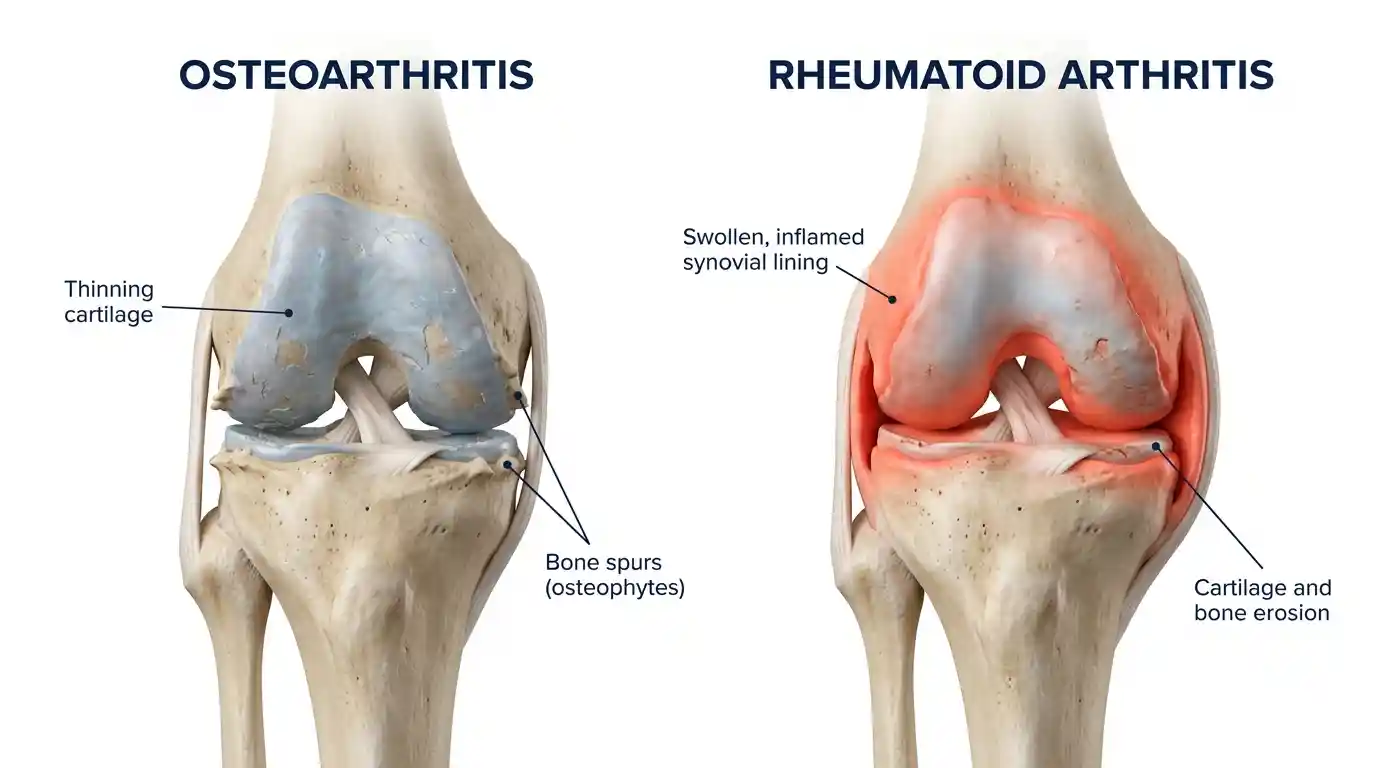
Osteoarthritis is the most common cause of knee pain in adults over 50. Over time, the cartilage that cushions the joint thins, and the synovial lining becomes inflamed.
What it feels like:
- A deep, dull ache inside the knee
- Stiffness in the morning or after sitting, which then eases within 20–30 minutes
- Creaking or grinding when you bend and straighten the knee
- Swelling that comes and goes
- Pain that gets worse with activity but improves with rest
Who it affects: Women develop it more often than men, especially after the menopause. Similarly, a previous knee injury, extra body weight and family history all raise the risk.
How Doctors Diagnose and Treat Osteoarthritis
According to NICE guidance, doctors usually diagnose osteoarthritis from your symptoms and an examination alone. Therefore, you only need imaging if your doctor suspects something unusual.
Watch: Part 1: What Is Knee Osteoarthritis? and Part 2: Why Does Knee Osteoarthritis Hurt?
First-line treatment includes exercise, weight management and physiotherapy. However, when these do not give enough relief, suitable patients with mild to moderate knee osteoarthritis may consider the Arthrosamid injection. It is a single, ultrasound-guided hydrogel injection, and you will find the full price and booking details below.
2. Rheumatoid Arthritis
In rheumatoid arthritis (RA), the immune system attacks the joint lining. Unlike osteoarthritis, wear and tear does not cause it. Instead, it can start at any age, and it affects women about three times more often than men.
- It often affects both knees at the same time
- Morning stiffness lasts more than an hour
- The joints feel warm, swollen and tender
- You may also feel tired and generally unwell
- It also tends to affect the hands, wrists and feet
Key tests: Doctors check blood for rheumatoid factor, anti-CCP antibodies and inflammation markers (CRP, ESR). Because early treatment protects the joints, do not wait if this pattern sounds familiar.
3. Gout
Uric acid crystals inside the joint cause gout. Most people link it with the big toe; however, the knee is one of the next most common sites, especially in men over 40.
- Sudden, severe pain that often starts overnight
- A hot, red, shiny and very tender knee
- Attacks that settle in 7–10 days but return if uric acid stays high
Triggers: For example, dehydration, alcohol (especially beer), purine-rich foods such as red meat, shellfish and offal, and some medicines such as diuretics.
Key tests: A blood test measures uric acid. Even so, joint fluid analysis under a microscope gives the most reliable answer.
4. Pseudogout (CPPD)
Pseudogout looks like gout, but calcium pyrophosphate crystals cause it instead. In fact, the knee is the joint it affects most often. It mainly affects older adults, and doctors also link it with hyperparathyroidism, haemochromatosis and low magnesium.
Key tests: Joint fluid analysis confirms it. In addition, an X-ray may show calcium deposits in the cartilage (chondrocalcinosis).
5. Septic Arthritis (Emergency)
In septic arthritis, bacteria infect the inside of the joint. Because bacteria can damage cartilage within hours, speed matters.
Go to A&E or call 111 now if your knee suddenly becomes very painful, hot, red and swollen and you feel feverish or unwell.
- Severe pain that develops over hours
- Fever and chills
- You cannot bend the knee or put weight on it
Your risk rises after a recent infection, joint injection or surgery. Likewise, rheumatoid arthritis, diabetes or a weak immune system also increase it. Hospital teams treat it with joint aspiration and intravenous antibiotics.
6. Lupus (SLE)
Lupus is an autoimmune condition that can affect almost any organ. Notably, joint pain and swelling, including in the knees, often appear early. Unlike RA, however, lupus rarely causes permanent joint damage.
Other clues include a butterfly-shaped rash across the cheeks, sun sensitivity, mouth ulcers, hair loss and unexplained fatigue. Lupus also affects women of childbearing age far more often than men.
7. Psoriatic Arthritis
Up to about 30% of people with psoriasis develop psoriatic arthritis. Often, it involves the knee, and usually on one side only.
- It typically affects one knee but not the other
- Morning stiffness
- Whole finger or toe swelling (“sausage digits”)
- Nail pitting, or nails lifting from the nail bed
Joint pain can appear before any skin rash. Therefore, tell your doctor if psoriasis runs in your family.
8. Reactive Arthritis
An infection elsewhere in the body triggers reactive arthritis. For example, it can follow food poisoning or a sexually transmitted infection such as chlamydia. However, the infection does not reach the joint itself.
Symptoms usually start 1–4 weeks after the infection, often in one knee or ankle. Sometimes sore red eyes, burning when you pass urine, or mouth ulcers also appear. Fortunately, most cases settle within a few months.
9. Lyme Disease
Tick bites spread Lyme disease, including in UK woodland, heathland and parks. If nobody treats it early, it can cause Lyme arthritis weeks or months later. In particular, it targets the knee more than any other joint.
Clues include a large swollen knee that, surprisingly, does not hurt much, a past tick bite, or a spreading “bull’s-eye” rash. A blood test confirms it, and antibiotics then treat it.
10. Hip Problems Felt in the Knee
Doctors miss this cause more than any other. Because the hip and knee share nerves, a hip problem can produce pain only in the knee.
- Adults: hip osteoarthritis can cause thigh and knee pain even when the knee looks normal.
- Children and teenagers: a limp with knee pain can signal a hip condition such as SUFE (a slipped growth plate) or Perthes disease, so they need urgent assessment.
For this reason, a good clinician always examines the hip when the knee looks normal but hurts.
11. Bursitis and Baker’s Cyst
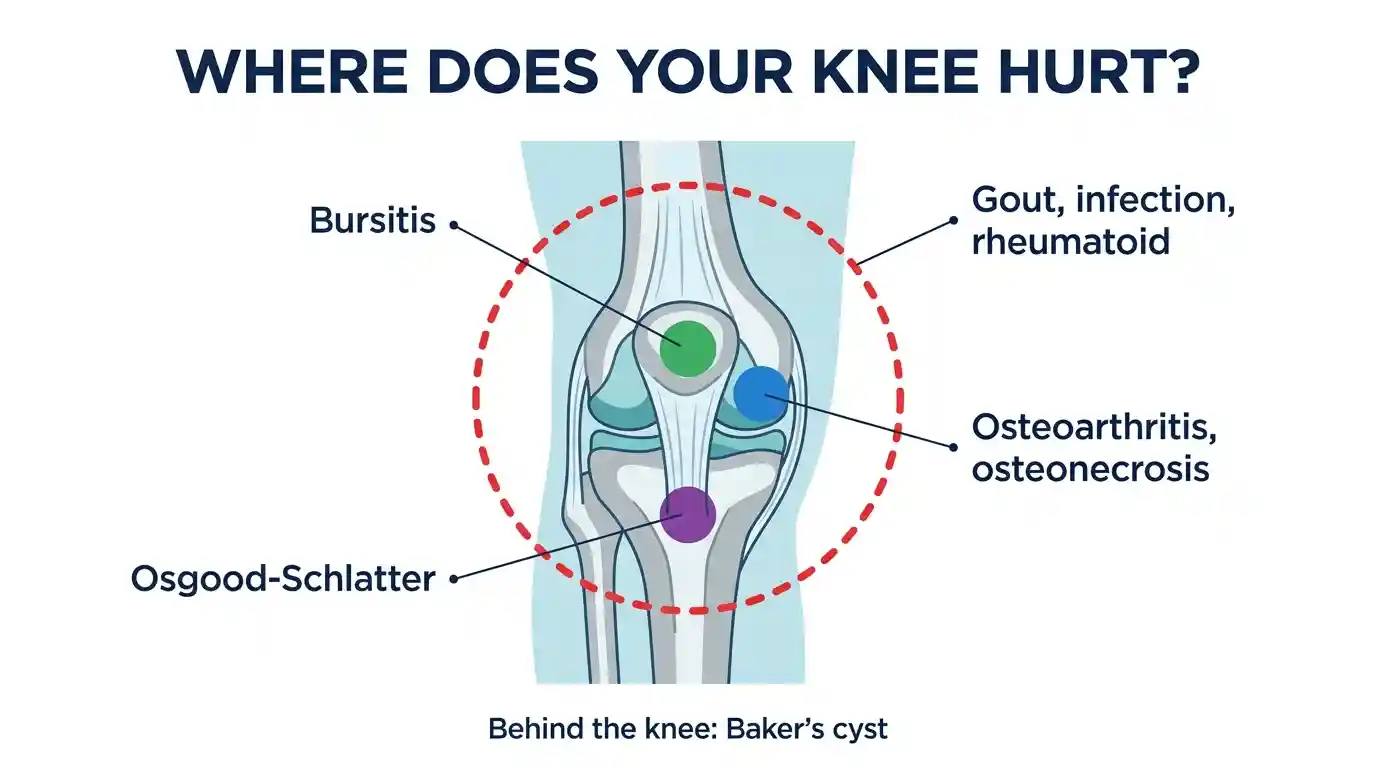
Prepatellar bursitis (“housemaid’s knee”) causes a soft swelling over the front of the kneecap. It is common in people who kneel a lot, for instance plumbers, cleaners and gardeners.
In contrast, a Baker’s cyst forms behind the knee, usually because of underlying arthritis or a cartilage tear. If it bursts, the calf turns painful and swollen, which can look like a blood clot (DVT). So always get a swollen calf checked urgently.
12. Spontaneous Osteonecrosis of the Knee
This condition causes sudden, severe pain on the inner side of the knee, often in people over 60 and more often in women. Typically, the pain worsens at night, and there is no injury. Because early X-rays may look normal, you will usually need an MRI.
13. Osgood-Schlatter Disease
Osgood-Schlatter affects active children and teenagers during growth spurts. It causes pain and a bony bump just below the kneecap, where the patellar tendon pulls on the growing shinbone.
Running and jumping make the pain worse, while rest eases it. Eventually, it settles once growth finishes.
14. Osteosarcoma and Other Bone Cancers
Osteosarcoma most often develops around the knee in teenagers and young adults. Ewing sarcoma can also occur here.
See your GP promptly if a young person has: bone pain that persists, night pain that rest does not ease, unexplained swelling, or a lump near the knee. Although these cancers are rare, early detection makes a real difference.
How to Tell These Conditions Apart
You often cannot tell them apart from symptoms alone. Still, the pattern gives strong clues:
| Condition | How it starts | Typical patient | Key clue | Test that helps |
| Osteoarthritis | Gradual, months to years | Over 50, women more | Stiffness under 30 min, grinding | Clinical exam (X-ray if needed) |
| Rheumatoid arthritis | Weeks | Any age, women 3x | Both knees, stiffness over 1 hour | RF, anti-CCP blood tests |
| Gout | Overnight | Men over 40 | Hot, red, extremely tender | Joint fluid, uric acid |
| Pseudogout | Hours to days | Older adults | Knee is the commonest joint | Joint fluid, X-ray |
| Septic arthritis | Hours | Higher-risk groups | Fever, cannot move knee | Emergency aspiration |
| Psoriatic arthritis | Weeks | Psoriasis history | One knee, nail changes | Clinical, imaging |
| Reactive arthritis | 1–4 weeks after infection | Young adults | Recent gut or urinary infection | Clinical, swabs |
| Lyme arthritis | Weeks to months after tick bite | Walkers, outdoor workers | Big swelling, mild pain | Blood test |
| Referred hip pain | Gradual | Older adult or limping child | Normal knee exam | Hip exam, hip X-ray |
| Osteonecrosis | Sudden | Over 60 | Night pain, inner knee | MRI |
| Osgood-Schlatter | Gradual | Active 10–15 year-olds | Bump below kneecap | Clinical |
| Bone cancer | Gradual, persistent | Teens, young adults | Night pain, lump | X-ray, urgent referral |
Ultimately, a proper diagnosis combines your history, an examination, blood tests and sometimes imaging (X-ray, ultrasound or MRI). No article can replace that.
Disease or Injury: Which Is It?
Disease-related knee pain usually starts gradually with no incident. It also feels worse in the morning or after rest, may affect both knees, and can come with fatigue, rashes, fever or pain in other joints.
Injury-related knee pain, on the other hand, follows a twist, fall or collision. It starts suddenly, sits in one specific spot, and imaging then shows a tear, fracture or ligament injury.
That said, the line is not always clean. For example, a knee with underlying osteoarthritis may not recover from a minor sprain as you expect.
When to See a Doctor
Book a GP or Specialist Appointment If
- Pain has lasted more than a few weeks and is not improving
- It disturbs your sleep, work or daily activities
- You notice swelling, redness or warmth
- Morning stiffness lasts more than 30 minutes
- Other joints also hurt
Get Urgent Help (A&E or 111) If
- The knee is hot, swollen and very painful, and you also have a fever
- You cannot put weight on the leg
- Your calf suddenly becomes painful and swollen
- A child has a limp with knee pain and fever, or cannot walk
Finally, see your GP without delay if you notice a persistent lump or unexplained bone pain, especially if you are under 40.
Treatment Options for Knee Osteoarthritis at Dr SNA Clinic
Once your doctor finds the cause, they can match treatment to it. For knee osteoarthritis, the clinic offers several doctor-led options:
- Arthrosamid injection: a single non-biodegradable hydrogel injection (97.5% water, 2.5% polyacrylamide) for mild to moderate knee osteoarthritis.
- PRP therapy: the clinic prepares platelet-rich plasma from your own blood. In fact, it uses the same autologous PRP technique across its specialities, from joint care to men’s health treatments such as the P-Shot (Priapus Shot).
- Shockwave pain management: a non-invasive therapy that patients can also combine with other treatments.
- Stem cell therapy and BMAC therapy: regenerative options for selected patients.
What Is the Arthrosamid Injection?
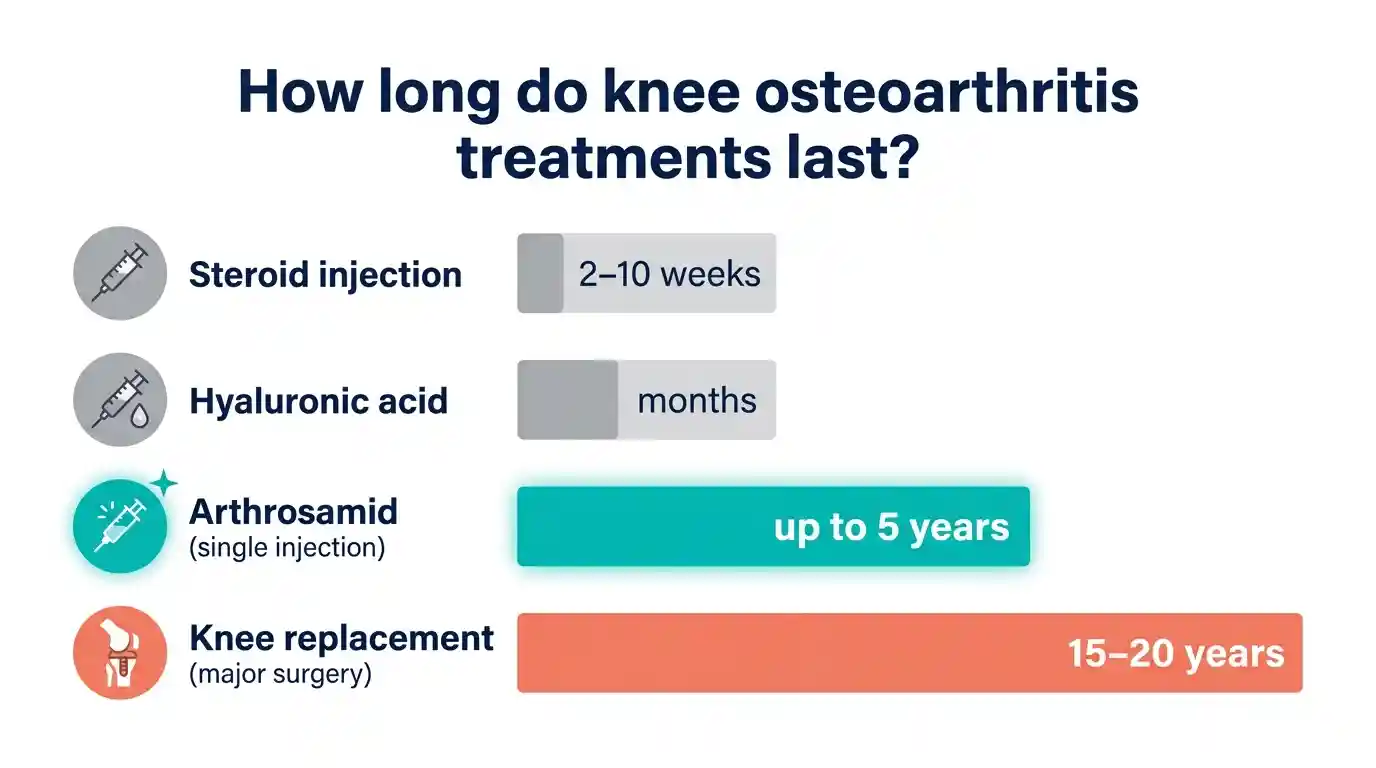
Arthrosamid works by integrating with the synovial lining of the knee, rather than simply lubricating it. In published studies, a single injection gave lasting improvement in pain and function for up to 5 years in study participants. Moreover, clinicians have now treated more than 20,000 patients worldwide (official Arthrosamid figures, January 2026). Results vary between individuals, however, and it does not cure arthritis.
Watch: Part 7: How Arthrosamid Works
| Detail | Arthrosamid at Dr SNA Clinic |
| Procedure time | 30–45 minutes, outpatient |
| Anaesthetic | Local anaesthetic only, no general anaesthetic |
| Guidance | Ultrasound guidance for accurate placement |
| Sessions | Single injection |
| Downtime | 3–5 days of reduced activity |
| Results start | Around 4–6 weeks; main improvement at weeks 8–12 |
| Results last | Up to 5 years in published follow-up studies |
| Who performs it | Mr S N Abbas personally, every time |
Arthrosamid Injection Price in London
| Option | Price | What you get |
| One knee | £2,800 (was £3,200) | Consultation with Mr Abbas, ultrasound-guided injection, follow-up, enhanced recovery support (physio guidance, supplement advice) |
| Both knees | £5,300 (was £6,400) | The same package, for suitable patients with symptoms in both knees |
| Consultation | £100 | Fully redeemable against treatment if you go ahead |
In addition, 0% finance lets you spread the cost. The clinic charges no hidden fees, and you have no obligation to proceed after your consultation. Prices apply at the time of publication, and the clinic confirms your final cost at consultation.
Who Is Arthrosamid Suitable For?
It may suit you if you have confirmed mild to moderate knee osteoarthritis and you have already tried physiotherapy, weight management or painkillers. Similarly, it may help if steroid or hyaluronic acid injections gave you only short-lived relief.
It may not suit you if you have a polyacrylamide allergy, an active knee infection, recent knee surgery or severe joint damage. Likewise, it will not help if another condition causes your knee pain.
How to Book Your Arthrosamid Consultation
- First, book online at drsnaclinic.com/booking, call, or message on WhatsApp. You can self-refer, so you do not need a GP referral.
- Next, Mr Abbas takes your history, examines your knee and reviews any imaging, or arranges it if needed.
- Then he gives you an honest recommendation. If Arthrosamid is not right for you, he will say so and discuss alternatives.
- On treatment day, he performs a 30–45 minute ultrasound-guided injection, and you go home the same day.
- Finally, you return for a follow-up review, usually at around weeks 8–12.
Clinic Address, Opening Hours and Contact
- Address: Dr SNA Clinic, 48 Wimpole Street, Marylebone, London W1G 8SF
- Opening hours: 10:00–18:00 (UK time)
- Phone: +44 7955 836986 (primary) · +44 20 3846 7111 (office)
- Email: [email protected]
- Book: drsnaclinic.com/booking
The Care Quality Commission (CQC) regulates the clinic, and Mr Abbas holds GMC registration (No. 6026154). He trained for over six years in NHS Trauma and Orthopaedics at Cambridge and Oxford. He also holds MRCSEd and an MSc with Distinction from Queen Mary University of London, and he has treated patients from more than 90 countries. Read Mr Abbas’s full profile.
Free Knee Osteoarthritis Video Series
Mr Abbas has also recorded a free 7-part video series on knee pain and osteoarthritis on the Dr SNA Clinic YouTube channel:
- What Is Knee Osteoarthritis?
- Why Does Knee Osteoarthritis Hurt?
- Where Does the Pain Really Come From?
- What Is Synovitis?
- How Do You Know If You Have Synovitis?
- Which Stage of Osteoarthritis Is Synovitis?
- How Arthrosamid Works
Quick Summary
- Most common: osteoarthritis
- Autoimmune, both knees: rheumatoid arthritis
- Sudden, severe, crystals: gout and pseudogout
- Emergency: septic arthritis
- Autoimmune with rash: lupus
- Linked to psoriasis: psoriatic arthritis
- After an infection: reactive arthritis, Lyme arthritis
- Most often missed: hip problems felt in the knee
- Swelling at the front or back: bursitis, Baker’s cyst
- Sudden night pain over 60: osteonecrosis
- Teenagers: Osgood-Schlatter; rarely osteosarcoma
The Bottom Line
Knee pain without injury deserves more than painkillers and hope. In many cases, it is the first sign of a condition that needs a proper diagnosis.
Fortunately, doctors can treat most of these conditions well, especially when they catch them early. So if knee pain is affecting your walking, sleep or work, book a consultation with Mr Abbas at 48 Wimpole Street, or call +44 7955 836986.
This article offers general information only and does not replace medical advice. If you are worried about your knee, speak to a qualified healthcare professional.
FAQ section
Each question now has its own H3/H4 subheading, so no block runs past 300 words. Answers stay at 40–60 words for featured snippets.
Frequently Asked Questions
What disease starts with knee pain?
Osteoarthritis is the most common one, especially after 50. However, knee pain without injury can also be the first sign of rheumatoid arthritis, gout, pseudogout, psoriatic arthritis, lupus, reactive arthritis or Lyme disease. In children, it may point to Osgood-Schlatter disease or a hip problem. Above all, a hot, swollen knee with fever needs emergency care.
Can knee pain be a sign of something serious?
Yes, sometimes. For example, a hot, red, swollen knee with fever can mean septic arthritis, which is an emergency. Similarly, persistent night pain or a lump in a young person needs an urgent GP visit. Finally, sudden calf swelling with knee pain can signal a burst Baker’s cyst or a blood clot.
Why does my knee hurt when there is no injury?
The most common reasons are osteoarthritis, inflammation of the joint lining (synovitis), crystal arthritis such as gout, or an autoimmune condition. In addition, a problem in the hip can cause pain you feel in the knee. Fortunately, a doctor can usually narrow it down from your history, an examination and, if needed, blood tests or imaging.
What autoimmune disease starts in the knees?
Rheumatoid arthritis, psoriatic arthritis and lupus can all start with knee pain. Rheumatoid arthritis usually affects both knees and the small hand joints, with morning stiffness over an hour. In contrast, psoriatic arthritis often affects one knee and comes with nail or skin changes. Blood tests then help your doctor confirm which one you have.
Can hip problems cause knee pain?
Yes. Because the hip and knee share nerves, hip osteoarthritis can produce pain only in the knee. Likewise, in children, a limp with knee pain can signal a hip condition such as SUFE or Perthes disease. Therefore, if your knee examination looks normal, your clinician should always check the hip.
How much does an Arthrosamid injection cost in London?
At Dr SNA Clinic, Arthrosamid costs £2,800 for one knee and £5,300 for both knees. The price also covers your consultation, the ultrasound-guided injection, follow-up and recovery support. In addition, the £100 consultation fee counts towards treatment, and 0% finance is available. The clinic confirms your final price at consultation.
How long does Arthrosamid last, and when does it start working?
Most patients notice improvement around 4–6 weeks after a single injection, and the main benefit usually appears at weeks 8–12. Moreover, published follow-up studies reported lasting improvement for up to 5 years in study participants. However, results vary from person to person, and the injection does not cure arthritis.
Do I need a GP referral to see a knee specialist privately?
No. Instead, you can self-refer to Dr SNA Clinic at 48 Wimpole Street, London W1G 8SF. Simply book online at drsnaclinic.com/booking or call +44 7955 836986. The clinic opens 10:00–18:00 (UK time), and your £100 consultation fee also counts towards treatment.
Read more:
Ultrasound-Guided Arthrosamid: Why Not Every Practitioner Can Do It Properly
How Long Do Arthrosamid Results Last? Cost, Evidence & What UK Patients Should Know


