
Sarah, a 58-year-old woman in Manchester, struggles to walk up the stairs without wincing. Her knees ache every morning. Grocery shopping leaves her exhausted and in pain.
Her GP referred her for cortisone injections. The first one worked well — pain-free for two months. The second lasted six weeks. By the third, relief barely made it to three weeks.
She didn’t want surgery. She just wanted her life back.
Then her consultant mentioned Arthrosamid. Twelve months later, Sarah walks her dog every morning and is back at her weekly yoga class.
Thousands of patients across the UK are now asking the same question — what exactly is Arthrosamid, how does it differ from cortisone, and which one lasts longer?
What Is a Cortisone Injection?
Cortisone is a steroid that has been used in medicine for decades. Doctors inject it directly into a painful joint — most commonly the knee, hip, or shoulder.

It works by reducing inflammation quickly. Most patients feel relief within a few days. It is widely available, fast, and relatively cheap.
But here is the problem. Cortisone does not fix anything. It quietens inflammation temporarily while the underlying condition keeps progressing. The cartilage continues to wear down. And the pain comes back.
How Long Does Cortisone Last?
On average, cortisone injections last between four and twelve weeks. Some patients get longer relief. Others notice it wearing off within two to three weeks.
Repeated cortisone injections can also damage the joint over time. Research suggests that more than three or four injections in the same joint can accelerate cartilage breakdown. Most guidelines now recommend no more than three to four injections per joint per year. After that, patients are often left wondering what comes next.
What Is Arthrosamid?
Arthrosamid is not a steroid or a painkiller. It works in a completely different way.
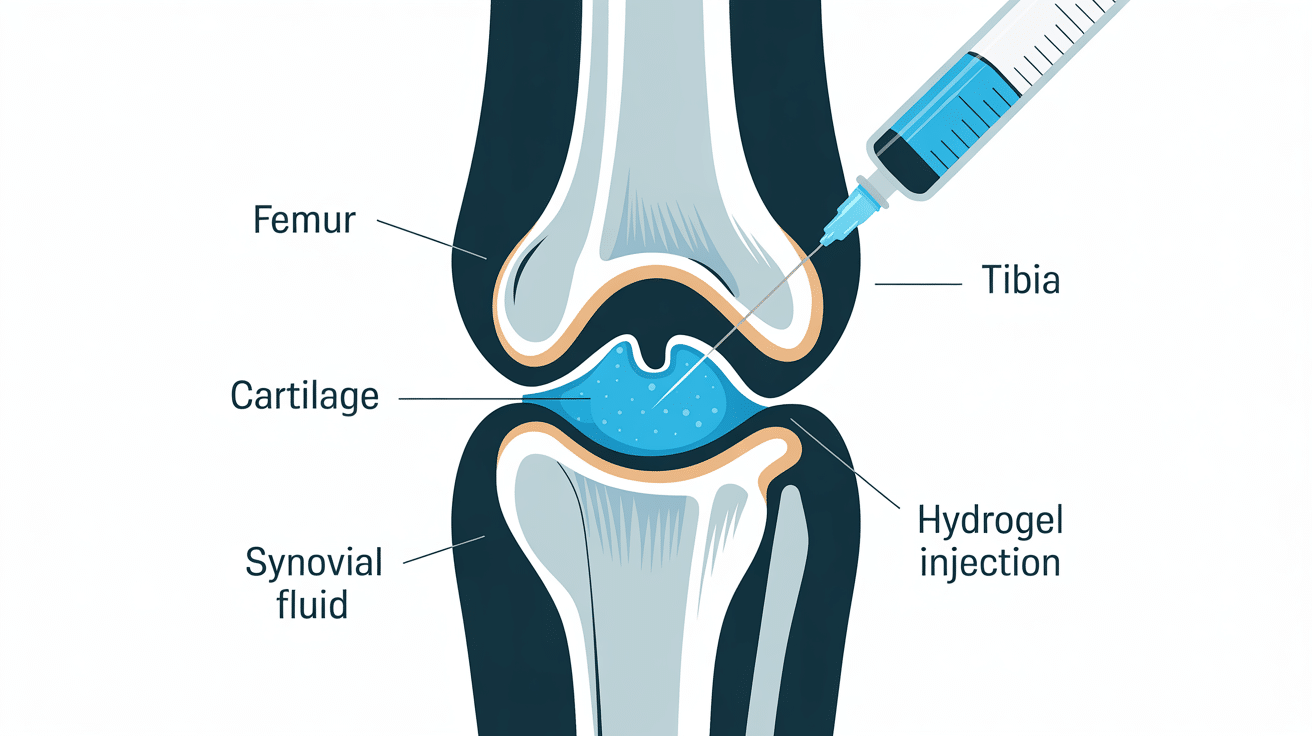
It is a polyacrylamide hydrogel — a soft, water-based gel injected directly into the knee joint. Once inside, it integrates into the synovial tissue, the soft lining of the joint. It cushions, lubricates, and supports the joint from within. It reduces friction, absorbs shock, and importantly, reduces pain.
Unlike cortisone, Arthrosamid does not dissolve or break down in the body. It stays in place. That is what makes it so different.
How Is the Procedure Done?
The procedure is done in a clinic, not a hospital. No general anaesthetic is needed.
A doctor cleans the knee and applies a local anaesthetic. The gel is then injected into the joint space using a fine needle under ultrasound guidance for precision. The whole procedure takes around 30 to 45 minutes. Most patients go home the same day.
Some mild swelling or discomfort is normal for a few days after. Recovery is generally quick. Improvement builds gradually over four to six weeks as the gel integrates into the synovial tissue.
Arthrosamid vs Cortisone: Key Differences
| Cortisone | Arthrosamid | |
| How it works | Reduces inflammation chemically | Cushions and supports joints physically |
| Speed of results | A few days | 4 to 6 weeks |
| Duration of relief | Weeks to a few months | Up to 5 years |
| Effect on the joint | Can damage cartilage with repeated use | Non-degradable, biocompatible |
| Injections needed | Repeat every few months | Single injection |
| Best for | Acute inflammation, early arthritis | Mild to moderate knee osteoarthritis |
Which Lasts Longer?
Arthrosamid lasts significantly longer.
Clinical studies show meaningful pain reduction sustained at the one-year follow-up and beyond — with evidence supporting relief for up to five years from a single injection.

Compare that to cortisone, which typically fades within weeks. For patients tired of repeat injections and short-lived relief, Arthrosamid offers something genuinely different.
It is not a cure. But for many patients it buys meaningful time — sometimes years — before more invasive treatments like knee replacement become necessary.
Side Effects
Cortisone side effects include temporary pain flare after injection, skin thinning, raised blood sugar in diabetic patients, and joint damage with repeated use.
Arthrosamid side effects are generally mild — temporary swelling, stiffness, or discomfort in the first few days. Serious adverse events are rare. Because it contains no steroids, it avoids the systemic side effects associated with cortisone.
As with any injectable treatment, infection is a small but real risk with both procedures. Always choose a qualified, experienced clinician.
Who Is a Good Candidate?
Arthrosamid is designed specifically for knee osteoarthritis. You may be a good candidate if you:
- Have been diagnosed with knee osteoarthritis
- Have tried cortisone with disappointing results
- Want to avoid or delay knee replacement surgery
- Want longer-lasting relief with fewer repeat treatments
It is generally not recommended for patients with severe end-stage arthritis, active joint infection, allergy to polyacrylamide, or recent knee surgery. A thorough consultation is essential before proceeding.
Arthrosamid Injection Cost UK
At Dr SNA Clinic in London, the pricing is as follows:
| Treatment | Price |
| Single knee | £2,800 |
| Both knees | £5,300 |
| Initial consultation | £100 (redeemable against treatment) |
Every treatment includes:
- Comprehensive consultation with a knee pain expert
- Ultrasound-guided Arthrosamid injection
- Post-injection physiotherapy guidance and supplement advice
- Follow-up assessment and ongoing support
- Flexible 0% finance plans available
That may sound expensive compared to cortisone at £150 to £300 per injection. But factor in repeat injections every few months, diminishing returns, and potential joint damage — and Arthrosamid becomes more cost-effective over time for the right patient.
Read More: Arthrosamid Injection Cost
When searching for Arthrosamid injections near me, always check the clinician’s qualifications carefully. Dr SNA Clinic is based at 48 Wimpole Street, Marylebone, London — one of the UK’s most respected medical districts.
Why the Clinician’s Experience Matters
Arthrosamid is a precision treatment. The gel must be placed accurately inside the joint space.
A clinician with both surgical anatomy training and injectable pharmacology expertise brings a dual perspective that most general practitioners simply do not have. This combination of MRCS surgical training and MRCGP-level pharmacology knowledge means a clinician understands exactly how the knee joint is structured, how the gel behaves once injected, and how to assess patient suitability safely.
Always ask about your provider’s qualifications and experience with Arthrosamid specifically before booking.
Cortisone Still Has Its Place

It would be unfair to dismiss cortisone entirely. For patients with acute joint inflammation — perhaps following an injury or a sudden flare — cortisone provides fast, meaningful relief. It is quick, well-understood, and widely accessible.
The problem is when cortisone becomes a long-term crutch. That is where the risks start to outweigh the benefits. At that point, Arthrosamid makes good clinical sense.
Think of cortisone as a short-term firefighter. Arthrosamid is the renovation — it addresses the structural problem and provides lasting stability.
The Bottom Line
If you are living with knee pain and feel like cortisone has stopped working, you are not alone.
Arthrosamid changes that conversation. It is clinically supported, longer-lasting, and works differently to cortisone without its drawbacks. For the right patient, it can be genuinely life-changing — just ask Sarah.
Speak to a qualified clinician who can assess your knee properly and give you honest, expert advice. The goal is simple — less pain, more movement, and a better quality of life.
Thinking about Arthrosamid? Book a consultation at Dr SNA Clinic to find out if you are a suitable candidate.
Read More:
Is Arthrosamid Injection the Right Knee Pain Treatment for You?


